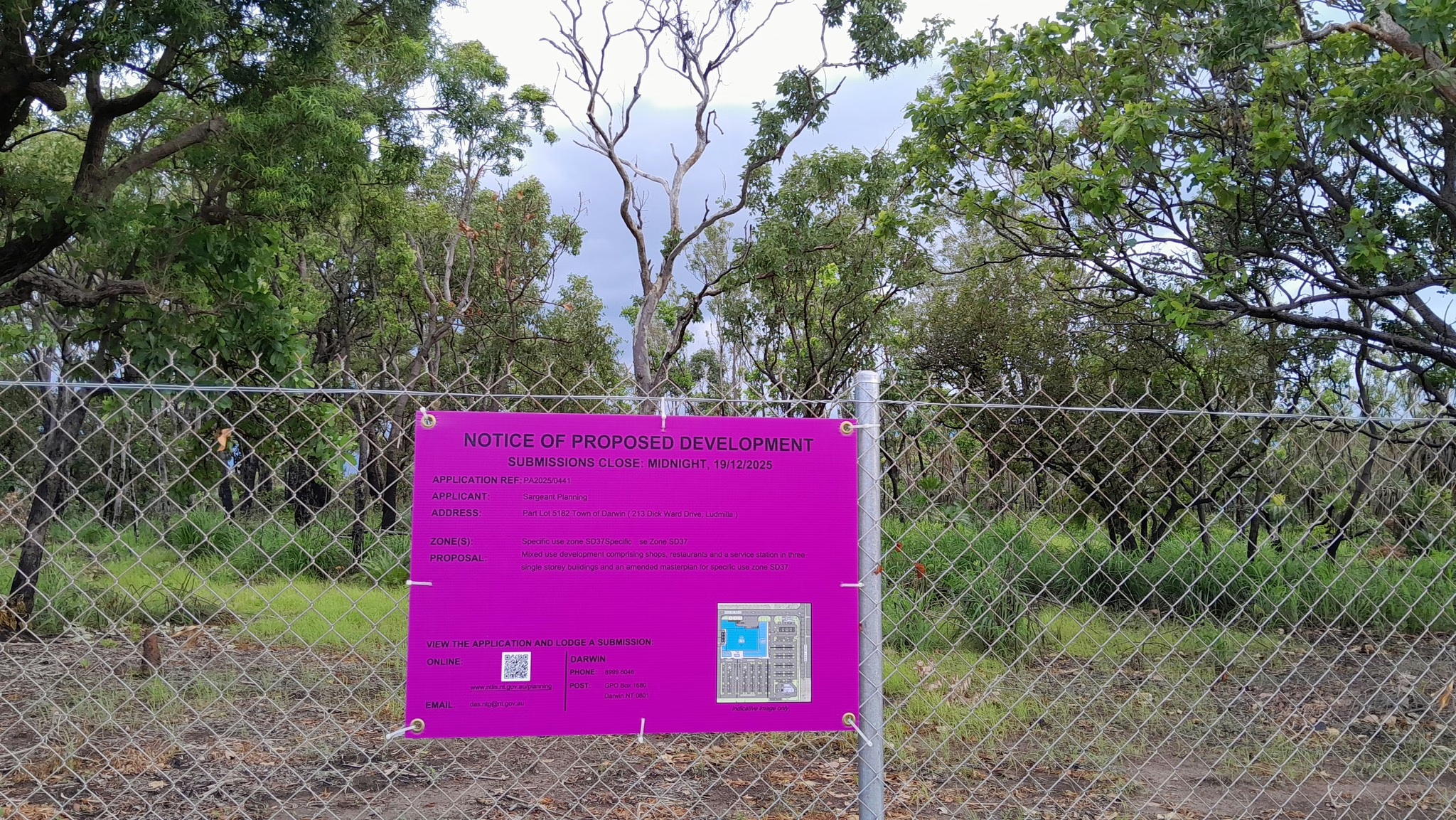
There are clear limits to public scrutiny in the Northern Territory planning system. Despite Minister Burgoyne’s claim that the Planning Act 1999 contains “robust provisions for public consultation and input”, recent experience suggests that this is not how the system operates in practice. Key risks and objections can be raised by the community, yet still be set aside or deferred so they are not resolved before approval.
That is what has just occurred in development application PA2025/0441 for part of the Kulaluk lease, known as the Ludmilla bush block, a beautiful 32 ha piece of unique native bushland in the Darwin mid suburbs between Fitzer Drive and Totem Road. Stage 1 of a proposed multi-staged commercial development by the Jape family has just been approved by the Development Consent Authority on a 16 ha part of the block. Stage 1 comprises a shopping centre complex, including a supermarket, retail tenancies, restaurants, a 24-hour service station and a roughly 500 place car park, possibly the largest in Darwin.
There were 35 public submissions, 34 opposing and one in support. The City of Darwin also objected, and the Airport Development Group requested detailed airport safeguarding conditions.
Community volunteers supported by PLan prepared well-researched submissions identifying critical gaps in the exhibited application material. This scrutiny led to requests from Development Assessment Services (DAS) for further information from the development proponent and subsequent revisions to the exhibited material, including further studies.
Despite those revisions, key issues remained unresolved, yet the Development Consent Authority (DCA) approved the application anyway, leaving some issues to be addressed through conditions and others considered outside the scope of the Stage 1 application. Those unresolved issues include matters that have implications for community safety.
To take one example, the hydrology modelling relied on in the decision does not incorporate increased rainfall intensities or sea level rise associated with climate change. Specific safeguards raised in submissions, including the City of Darwin’s request for climate-adjusted hydrology using Australian Rainfall and Runoff 4.2, were not required before approval and are not reflected in the conditions.
In addition, some issues were not allowed to be raised at the DCA hearing for PA2025/0441 on 6 March 2026 because they were considered outside scope. For example, Margaret Clinch, who founded PLan 30 years ago, was prevented from raising concerns about the proposed use of adjoining Restricted Development (RD) zoned land for a contamination containment cell to receive contaminated material from the Stage 1 development site, including uncontrolled fill of unknown origin, asbestos-containing material, PFAS and hydrocarbon contamination.
Another PLan volunteer was also prevented from presenting cultural heritage material relating to the broader Kulaluk cultural landscape, even though the DAS assessment report itself acknowledges that context and records the Heritage Branch recommendation for a cultural heritage investigation and heritage impact statement.
Community submissions, along with those from the City of Darwin and the Airport Development Group, raised concerns about hydrology and contamination, traffic, airport safeguarding, the drainage function and habitat value of the native bushland site, as well as canopy loss and urban heat, all of which have implications for community safety.
These were not resolved at approval. Some were addressed through conditions, some were treated as outside Stage 1, or left to later stages or separate approvals. Some were not addressed at all. Many of those conditions rely on documents being submitted and approved rather than tested through any further public process, and approval depends on agency sign-off rather than independent scrutiny.
The DCA stated that its role is confined to matters it considers relevant to the application before it.
This points to a contradiction in how the NT planning system operates. The process relies on community submissions to identify deficiencies in development proposals and inform revisions to the exhibited material. At the same time, public scrutiny is constrained. The scope of what can be raised at a hearing is determined by what is considered relevant, and unresolved issues can be excluded or deferred to later stages through conditions or separate approvals.
The use of staging in this development application allowed the DCA to assess only Stage 1 rather than the development site as a whole. The proposed contamination containment cell on adjoining RD land was treated as outside this stage, even though the stage 1 development depends on it to manage contaminated material. Approval was therefore given without resolving, at the point of approval, how contaminated material that will be disturbed during Stage 1 construction will be managed. The same approach was taken to hydrology. Submissions raised the absence of integrated, climate-adjusted modelling and whole-of-site stormwater design, yet the DCA determined this was not required at this stage, with some but not all concerns carried forward through conditions.
While it is true, as noted by the DCA, that conditions are a normal part of planning systems, in other jurisdictions they are not typically used to carry unresolved matters with implications for public safety, such as how stormwater will be managed across a site under heavy rainfall or storm surge, how contaminated material will be excavated, stored and contained, whether safe and workable traffic access has been demonstrated, or whether the development will create unsafe heat conditions in neighbouring residential areas through the replacement of native bushland with extensive hard surfaces. Where these matters with implications for public safety have not been properly addressed in the application, approval is more likely to be delayed or refused until they are resolved, rather than assigned to conditions.
The issue is not how many conditions are imposed, but whether approval is being granted before key matters have been demonstrated, particularly those relating to public safety.
In a “robust” planning system, it would be expected that key risks and impacts are resolved before approval. As the example above shows, this is not what occurs in practice in the NT.
For 30 years, PLan has provided public scrutiny and community planning oversight at the only point where it still has effect, during the public notification period.
In February 2025, the Northern Territory Government refused PLan’s request for an operational grant, bringing to an end modest bipartisan funding that had been in place since 1995. The decision was based on the view that this scrutiny was not needed. Was this an attempt to further limit public scrutiny?
What the preceding discussion demonstrates is the clear limits to public scrutiny in the NT planning system, and the need for reform.
That reform should begin with clear mechanisms for ongoing public scrutiny where conditions are used, so that compliance and enforcement can be monitored. It should also address the use of staged applications and conditions to defer or exclude whole-of-site issues, so that key risks cannot be set aside or pushed into later processes without being resolved before approval. Restoring PLan’s operational funding is another essential step in strengthening transparency and public scrutiny in the NT planning system.